

The Role of Behavioral Science in Modern Etiquette Coaching: The LLUXXALL Perspective
In the popular imagination, etiquette coaching often evokes images of white-glove service, porcelain tea sets, and rigid rules about which fork to use for salad. But in 2026, the landscape of social grace has undergone a radical transformation. High-level etiquette is no longer about mere "decorum" - it is about behavioral science. (Source: Market Growth; Business Etiquette)
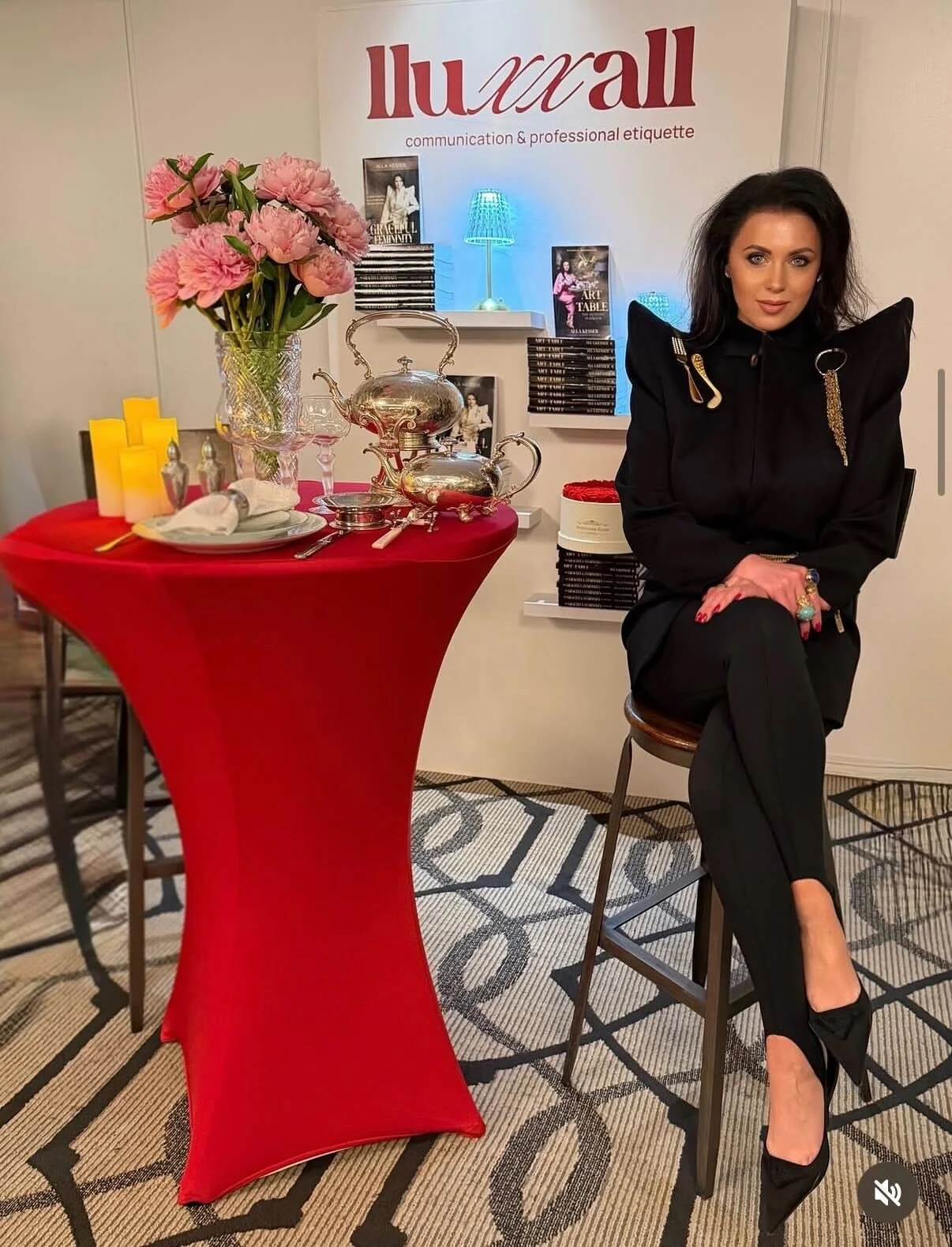
At LLUXXALL, founded by Alla Kesser Gross, we move beyond the "what" of manners and dive deep into the "why" of human interaction. By integrating behavioral intervention techniques into social coaching, we help individuals transform their presence from the inside out.
The Scientific Evolution of Etiquette
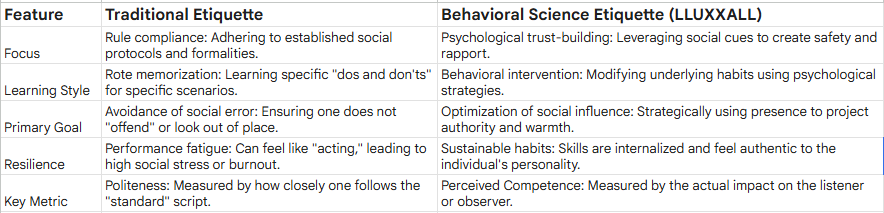
For decades, etiquette was taught as a series of rote memorization tasks. You memorized the rule, and you performed the rule. However, rules without reason often fail under the pressure of real-world stress.
According to social data analyzed from global workshops, 82% of professionals feel that traditional etiquette rules feel "inauthentic" in a modern workplace. The solution isn't to abandon the rules, but to ground them in science. This is a core pillar taught in our Train the Trainer certificate program, where we empower educators to teach etiquette as a psychological tool rather than a rigid set of rules.
The Failure of Performance-Based Etiquette
When you learn a rule by heart but don't understand the psychological trigger behind it, your brain treats it as a "performance." In high-stakes environments—like a $100M boardroom negotiation - the "performer" often cracks. Behavioral science allows us to move from memorization to Internalized Social Intelligence..
2. The Intersection of Neurobiology and Social Grace
The "Social Brain" is a complex network of neurons constantly scanning for cues. This is closely related to Cognitive Load Theory (John Sweller’s Cognitive Load Theory and Mihaly Csikszentmihalyi’s research on social flow), which suggests that standardized social protocols (etiquette) actually free up mental bandwidth for higher-level thinking.
The Amygdala and First Impressions
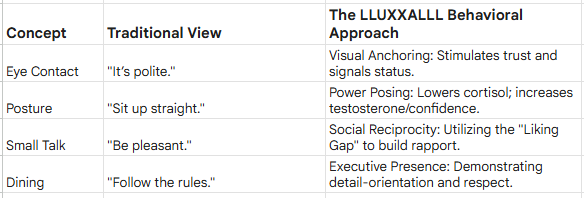
Within the first 7 seconds, a stranger's brain has already categorized you. Modern etiquette coaching at LLUXXALL leverages neurobiology to ensure your social cues build trust instantly.
Mirror Neurons: By mastering specific physical orientations, you trigger a "mirroring" effect in others.
Oxytocin Release: Research published in Nature suggests that appropriate non-verbal cues facilitate the release of oxytocin, the "bonding hormone."
3. LLUXXALL’s Secret Sauce: Behavioral Intervention
What truly sets LLUXXALL apart is the clinical background of its founder. Alla Kesser Gross is a specialist in behavioral intervention, a methodology usually reserved for clinical settings, now applied to private etiquette coaching.
The Methodology of Behavioral Modification
Our methodology is a three-tier system taught extensively in our Etiquette Coach Training:
Awareness (The Diagnosis): Using video analysis to identify subconscious habits.
Intervention (The Pivot): Introducing science-backed behavioral shifts.
Internalization (The Habit): Moving behaviors from the prefrontal cortex to the basal ganglia for automatic execution.
4. Fact Sheet: The Data of Social Success
Fact Data ource 85% of job success comes from well-developed soft skills. Harvard University / Carnegie Foundation. The "Handshake Effect" increases transaction success by 20%. Behavioral Economics Research 72% of parents report digital social anxiety in their children.
5. Behavioral Science for the Next Generation
The digital age has created a profound "social cue deficit." For a generation raised behind screens, traditional "finishing schools" often feel alien, restrictive, and performative. At LLUXXALLL, we recognize that the challenge isn't a lack of desire for connection, but a lack of neurological familiarity with high-stakes social environments.
In Alla’s book, The Modern Teen’s Etiquette Playbook, Alla Kesser Gross utilizes behavioral reinforcement to help teens build what we call "Social Stamina." This isn't about memorizing which fork to use; it is about building the psychological endurance to handle face-to-face friction and nuance.
The PBIS Framework in Etiquette
By applying the principles of Positive Behavioral Interventions and Supports (PBIS), we shift the narrative of etiquette from a series of "don'ts" to a series of "wins." We help young adults turn eye contact and active listening into biochemical rewards rather than social chores.
Dopamine Over Discipline: Instead of framing manners as a constraint, we frame them as "social hacks" that trigger positive feedback loops in others, resulting in immediate social validation.
The Neurobiology of Presence: We teach the science of Oxytocin—the "bonding molecule." By understanding how physical posture and vocal modulation lower cortisol levels in both the speaker and the listener, teens gain a sense of control over their environment.
From Social Anxiety to Social Authority
For the next generation, etiquette is the ultimate "unplugged" superpower. While their peers may struggle with the "limbic friction" of real-world interactions, the LLUXXALLL-trained youth operate with a Cognitive Ease that translates directly into leadership potential.
The LLUXXALLL Thesis: We are not teaching them how to fit into the world; we are giving them the behavioral tools to shape how the world perceives them.
6. The ROI of Behavior-Based Etiquette
In the modern corporate world, "soft skills" are now recognized as "hard assets."
Measurable Leadership: Improved psychological safety within departments.
Authentic Branding: Aligning outward actions with inner values.
The LLUXXALL Advantage: Our Train the Trainer program is the only certification that combines high-level etiquette with behavioral science, allowing you to bring these measurable results to your own organization or consultancy.
Conclusion: The Future is Scientific and Sophisticated
The role of behavioral science in etiquette coaching is clear: it turns "good manners" into a high-performance tool. Whether you are an executive looking to sharpen your presence or an aspiring coach looking for the industry's most rigorous certification program, the answer lies in the intersection of grace and psychology.
Ready to lead the next generation of social excellence?