

Soft Skills vs. Technical Skills: Which gets you promoted faster in 2026?
In the professional landscape of 2026, the definition of "competence" has undergone a radical transformation. For decades, the ladder to success was built on a foundation of technical mastery- coding proficiency, financial modeling, or legal expertise. However, as we move further into an era defined by generative AI and automated technical workflows, the "hard" skills that once guaranteed a promotion have become the baseline, not the differentiator.
The question for the modern professional is no longer, "Can you do the job?" but rather, "How do you show up while doing it?"

The Shift: Why Technical Excellence is No Longer the "Promotion Trigger"
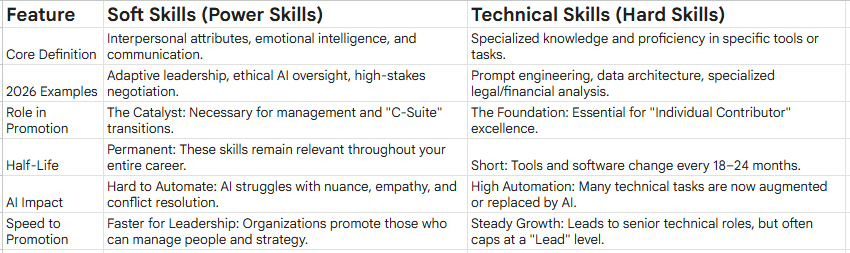
In 2026-2027, technical skills will have a shorter half-life than ever before. Software updates, new AI models, and shifting digital infrastructures mean that what you know today may be obsolete in eighteen months. Consequently, organizations have shifted their promotion criteria.
While technical expertise is required to enter a role, it is rarely the reason someone is moved into leadership. Promotions are now triggered by "Human Premium" traits: the ability to influence, the grace to navigate high-stakes conflict, and the presence to represent a brand to global stakeholders.
The Data of Distinction: Why 85% of Career Success is Non-Technical
The shift toward soft skills isn't just a corporate trend; it is backed by a century of research that has reached its boiling point in 2026. A landmark study conducted by Harvard University, the Carnegie Foundation, and Stanford Research Center concluded that 85% of job success comes from having well-developed soft skills, while only 15% comes from technical skills.
Furthermore, the World Economic Forum’s Future of Jobs Report emphasizes that as technical tasks are automated, the demand for "systemic thinking," "social influence," and "emotional intelligence" has skyrocketed. In short: technical skills get you the interview; soft skills get you the corner office.
The AI Paradox: How Automation Increased the Value of Etiquette and Presence
We live in the "AI Paradox." The more we delegate technical tasks to machines, the more we prize the qualities machines cannot replicate. You can use AI to write a report, but you cannot use it to host a high-stakes closing dinner or to command a boardroom during a merger.
In 2026, etiquette is the new power currency. It signals a level of discipline, respect, and social intelligence that suggests a person is ready for the responsibilities of leadership. When the "work" is done by an algorithm, the "value" is created by the person who can manage the human relationships surrounding that work.
Beyond the Resume: High-Impact Soft Skills for the 2026 Executive
To secure a promotion in today’s market, you must master three specific domains of the "Human Premium”:
The Art of Sophisticated Communication
It is no longer enough to be "clear." You must be persuasive. This includes the nuance of digital diplomacy - knowing when a Slack message is insufficient and a face-to-face meeting is required - and the ability to articulate complex ideas with executive brevity. Communication is more about the "vibe" and the medium rather than just words.
Digital Diplomacy: Knowing when a Slack message is fine for a status update, but a tough conversation needs the warmth of a video call.
Executive Brevity: The superpower of saying in two sentences what others take twenty minutes to ramble through.
Situational Awareness: Stripping away the fluff to get straight to the "so what," which immediately earns you a seat at the table.
2. Emotional Intelligence (EQ) as a Leadership Command Center
EQ is the ability to read a room and pivot your strategy in real-time. Leaders in 2026 are expected to manage diverse, often remote teams with empathy while maintaining strict professional boundaries and high standards of excellence. Think of Emotional Intelligence not as a "soft" trait, but as your most reliable piece of executive equipment- the radar that tells you what’s actually happening beneath the surface of a meeting. In 2026, being a boss who just barks orders is a relic of the past; today’s leaders need to be part-detective and part-psychologist. It’s about catching that split-second look of hesitation on a colleague's face during a Zoom call or knowing exactly when to push a team and when to let them breathe.
When you have high EQ, you aren't just reacting to problems; you’re anticipating them by reading the "vibe" of the office or the subtle shifts in a client’s tone. It allows you to deliver tough feedback in a way that actually motivates people instead of shutting them down. This ability to stay cool while everyone else is panicking creates a "calm-is-contagious" effect that makes people want to follow you. Ultimately, EQ is the difference between having a title and having actual influence; it’s what transforms a group of talented individuals into a loyal, high-performing team.
3. Modern Etiquette and the "Polished Professional" Aesthetic
Etiquette is often misunderstood as "which fork to use." In reality, it is the science of making others feel comfortable in your presence. Whether it is mastering the nuances of business dining or understanding global cultural protocols, a polished presence removes friction from business transactions.
Modern etiquette is the invisible architecture of a successful deal, functioning as a silent language of respect that establishes trust before a single word of business is spoken. By mastering these social nuances, a professional transitions from being a mere "service provider" to a trusted peer within high-value circles. This "Polished Professional" aesthetic goes beyond surface-level grooming; it is more about the poise of your posture, the intentionality of your eye contact, and the grace with which you handle unexpected social settings.
When you possess this level of refinement, you project a sense of self-discipline and reliability that reassures stakeholders you can handle the complexities of a leadership role. Ultimately, a sophisticated presence serves as a "soft power" tool that opens doors to exclusive opportunities where technical expertise alone is rarely enough to gain entry.
Why Women in Leadership Face a Higher "Soft Skill" Standard
For women, the path to the C-suite often involves navigating the "Double Bind"—the need to be seen as both highly competent and deeply relatable. In 2026, the standard for executive presence among female leaders is exceptionally high.
Soft skills, particularly those focused on confidence and authoritative grace, allow women to bypass traditional biases. By mastering the art of professional polish, women can ensure that their technical contributions are never overshadowed by a lack of social "fit" or presence.
The ROI of Refinement: How LLUXXALL Bridges the Leadership Gap
At LLUXXALL, we recognize that many brilliant women are "stuck" at the mid-to-senior management level despite having superior technical resumes. The missing link is often the "Executive Polish" that traditional education ignores.
Our etiquette classes for women are designed specifically for the 2026 landscape. Our goal is not manners; we teach Strategic Presence. We help you refine your non-verbal communication, your social confidence, and your ability to navigate the most exclusive professional circles in the world.
Case Study: From Technical Lead to C-Suite Presence
Consider a Senior Data Architect who was passed over for a VP role three times. Her technical output was flawless, but her feedback always cited a "lack of executive presence." After undergoing a 6-month refinement program focusing on social diplomacy and public speaking, she was promoted within one quarter. The difference wasn't her data—it was her delivery.
Common Myths: Why "Being Good at Your Job" is a Promotion Trap
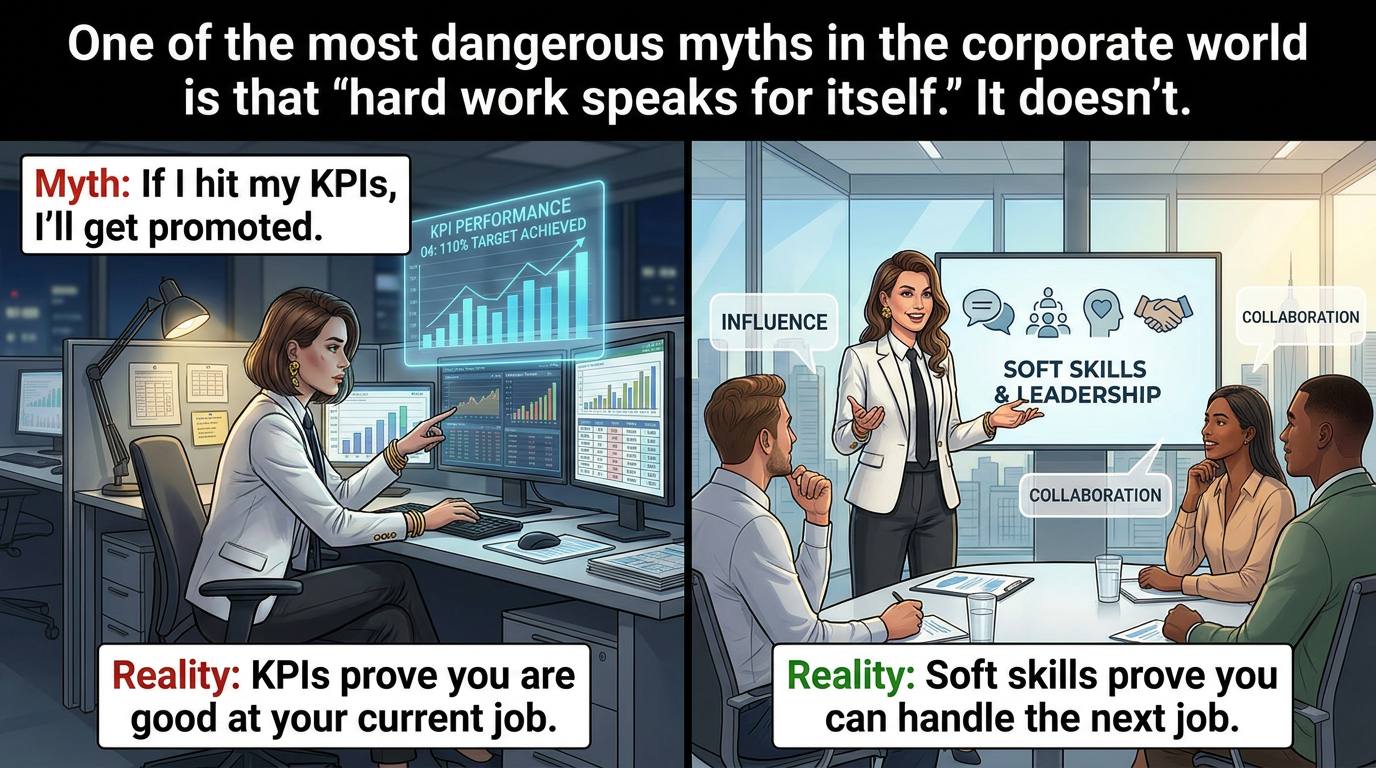
One of the most dangerous myths in the corporate world is that "hard work speaks for itself." It doesn't.
Myth: If I hit my KPIs, I’ll get promoted.
Reality: KPIs prove you are good at your current job. Soft skills prove you can handle the next job.
Strategic Steps to Audit and Elevate Your Soft Skill Portfolio
Record Your Presence: Watch a recording of your last virtual meeting. Do you command attention, or do you blend into the background?
Solicit "Vibe" Feedback: Ask a trusted mentor, "What is the one thing about my social presence that might be holding me back?"
Invest in Specialist Training: Stop taking more technical certifications and start investing in your personal brand and etiquette.
Contact Us
Ready to transform your technical expertise into a leadership legacy? Contact LLUXXALL today to learn more about our bespoke coaching for high-achieving professionals.
Client Reviews
"The training I received at LLUXXALL didn't just change how I eat at a business lunch; it changed how I walk into a boardroom. I feel like I finally have the 'secret code' to the executive level." — Director of Operations, Luxury Real Estate